Governed AI execution for complex analytical workflows.
Anna helps organizations move from natural-language questions to repeatable analytical workflows, multimodal outputs, and defensible provenance.
Instead of placing an AI model at the center of execution and then trying to control the uncertainty afterward, Anna starts with deterministic systems and embeds AI only where it adds value — interpreting intent, selecting among validated options, and explaining completed workflows.
Natural-Language Intent
Users ask complex analytical questions in plain language across data, geography, documents, models, and workflows.
Governed Execution
Deterministic systems handle data access, validation, joins, analytics, geospatial operations, pipelines, and artifact generation.
Defensible Outputs
Anna returns maps, charts, tables, summaries, dashboards, downloads, and provenance tied to the workflow that produced the result.
What Anna Is
Anna is a governed execution layer for AI-powered analysis. It connects natural-language interaction to deterministic workflows that can retrieve data, apply logic, run analytics, perform geospatial operations, generate outputs, and preserve provenance.
The platform is built for environments where answers need to be more than conversational. They need to be traceable, repeatable, reviewable, and operationally useful.
Deterministic-first
Anna begins with controlled systems, validated logic, registered data, and governed workflows.
AI where it helps
Language models support interpretation, selection, ambiguity resolution, and explanation without controlling execution.
Built for trust
Outputs are grounded in what the system did, including selected data, filters, computations, artifacts, and provenance.
The Problem Anna Solves
Many AI systems are impressive in demos but difficult to trust in production. When the same model interprets requests, decides what to do, triggers tools, and explains results, uncertainty in language can become uncertainty in execution.
Anna addresses this by keeping deterministic systems responsible for the work that requires precision: data access, validation, computation, geospatial processing, pipeline orchestration, artifact generation, and provenance.
- Natural-language access to complex analytical systems
- Governed data, metrics, entities, geographies, models, and pipelines
- Geospatial and entity-based analytics
- Maps, charts, tables, dashboards, downloads, and narrative explanations
- Execution-native provenance and traceable outputs
- Repeatable workflows that can be reviewed and defended
From Natural Language to Trusted Outputs
Anna is designed to turn complex questions into useful outputs that users can understand, inspect, and act on.
Instead of returning only a text response, Anna can produce maps, charts, tables, summaries, downloadable artifacts, and provenance grounded in the workflow that produced the result.
Example question
“What is the health risk from drought in Texas at the ZIP Code level, and which areas should we prioritize for intervention?”
Anna interprets the question using bounded AI, translates it into governed selections and deterministic execution, then returns outputs tied to the completed analysis.
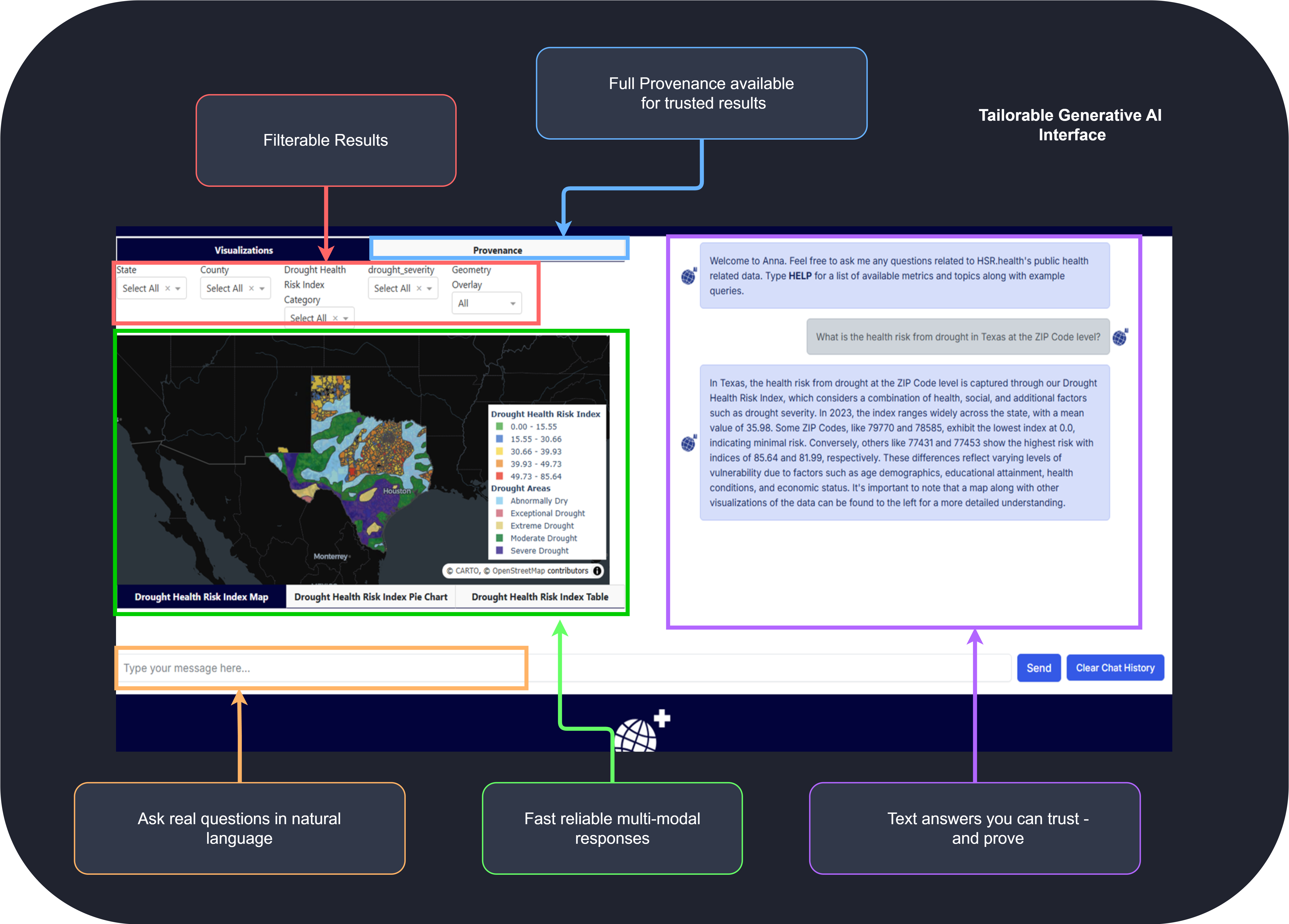
Interactive visual outputs
Maps, filters, and visual context help users explore and interrogate the completed result.
Underlying data access
Tables and downloadable outputs are tied directly to the completed analysis, not generated separately from it.
Built-in provenance
Users can see the data used, filters applied, workflow steps followed, and logic behind the answer.
Explore Anna
These pages explain Anna from different angles: how it works, where it starts, how it compares to adjacent platforms, and why its differentiation is designed to endure.
A Deterministic Architecture for Governed AI Execution
See how Anna separates interpretation, execution, and explanation so AI can improve usability without taking control of analytical workflows.
Explore the architecture →How Anna Fits Across the AI Landscape
Compare Anna with BI + AI platforms, foundation models, GIS platforms, vertical analytics, agent frameworks, RAG systems, and enterprise data platforms.
View the landscape →Focused First on Health, Geospatial, and Social Data Intelligence
Learn why Anna begins in markets where governed analytics, spatial reasoning, risk, and defensible outputs are especially valuable.
See the market focus →How Anna Maintains Its Differentiation
Understand why Anna’s advantage is architectural, how roadmap-based defensibility compounds, and why surface AI features are easier to copy.
Read about defensibility →Where Anna Starts
Anna is domain-agnostic by architecture, with initial customer focus in markets where governed analytics, spatial reasoning, and defensible outputs are especially valuable: health, geospatial intelligence, and social data intelligence.
That focus is grounded in where the platform came from. Anna emerged from health risk prediction and geospatial analytics work focused on how outcomes are influenced by social and environmental factors, including distance to care, environmental exposure, disaster vulnerability, and related risks.
Health
Health risk mapping, service access analysis, exposure analysis, vulnerability assessment, scenario planning, and medical supply inventory planning.
Geospatial Intelligence
Spatial overlays, administrative rollups, facility access views, risk surfaces, area comparisons, and downloadable geospatial artifacts.
Social Data Intelligence
Analysis across people, households, communities, places, conditions, and entity relationships through governed workflows.
How Anna Is Different
Across the AI landscape, many platforms are adding language models to existing capabilities and then focusing on how to control the uncertainty that comes with AI-led workflows.
Anna takes a different approach: it starts with deterministic execution and embeds AI only where it adds value — helping interpret intent, select among validated options, and explain the results of workflows the system can govern and reproduce.
Not just a chatbot
Anna does more than generate responses. It connects user intent to governed analytical execution.
Not just a dashboard
Anna can execute workflows that produce new maps, tables, charts, artifacts, and explanations from governed data.
Not just tool access
Anna governs how tools, data, models, and pipelines are used inside repeatable analytical workflows.
Why Anna Endures
Surface AI features like chatbots, copilots, dashboard summaries, and tool access can spread quickly across the market because they sit near the surface of the product experience.
Anna stays differentiated because the harder work sits beneath the interface: deterministic orchestration, governed execution, provenance, hybrid analytics, extensibility, and execution-aware explanation built together as architecture.
Architecture compounds
Each new capability strengthens the same governed execution foundation rather than existing as an isolated feature.
Roadmap deepens defensibility
Hybrid analytics, customer extensibility, provenance, and execution-aware knowledge become more valuable when built together.
Outputs stay defensible
Anna’s value grows as organizations need AI systems that can explain not only what they answered, but how they produced the answer.
Anna turns natural-language intent into governed execution.
It gives organizations a way to use AI where trust matters — combining flexible intelligence with deterministic systems, spatial and entity-based analytics, multimodal outputs, and defensible provenance.